The Real History of the Viet-Cajun Boil
The Real History of the Viet-Cajun Boil
Before it was a menu item, it was survival. The story of how a Louisiana tradition and a refugee community's hardest years produced one of the Gulf Coast's most enduring flavors.
Ask most people where Viet-Cajun crawfish comes from and they'll say Houston, sometime in the 2000s, at a restaurant with a name they half-remember. They're not wrong about Houston — that's genuinely where the style got its name and its first national spotlight. But the name and the origin are two different things, separated by roughly thirty years and a body of water most food writers never mention. The real story doesn't start in a dining room. It starts on the docks, and it starts with people who had every reason not to stay.
1975: A Wave Arrives on a Coast That Already Knew the Water
When Saigon fell in April 1975, it set off the largest single wave of Vietnamese immigration the United States had seen. Tens of thousands of refugees, many from fishing families along Vietnam's own coastline, were resettled across the Gulf South — Louisiana, Texas, Mississippi, Alabama. It wasn't a random landing. Resettlement agencies placed families in fishing communities on purpose, reasoning that people who'd spent generations on boats back home would find familiar footing in an economy built on shrimp, oysters, and crawfish.
In New Orleans specifically, the population grew from a few thousand in the late 1970s to more than 17,000 today — still the largest Vietnamese community in the region, still centered in New Orleans East, the same ground it took root in fifty years ago.
The logic of that placement turned out to be sound. What nobody accounted for was how the water already there would receive them.
The Water Wasn't Empty, and It Wasn't Welcoming
By the late 1970s, thousands of Vietnamese families had bought boats, learned the local waters, and begun shrimping up and down the Gulf Coast — and they were good at it, often working harder and longer than boats that had fished the same waters for generations. That success did not sit well with everyone already there.
Through the late '70s and into the early '80s, tension between Vietnamese and white shrimpers escalated in pockets across Texas and Louisiana — competition over territory, misunderstandings compounded by language barriers, and outright resentment over who had the right to fish where. It came to a head in Seadrift, Texas, in August 1979, when a dispute between a white shrimper and a Vietnamese fisherman ended in a fatal shooting. The killing set off a wave of retaliation — boats burned, homes threatened — and by 1981, tensions in Galveston Bay had drawn the attention of the Ku Klux Klan, who staged an armed boat patrol along the docks, burned a boat in effigy, and worked to intimidate Vietnamese fishing families out of the industry entirely.
It's a chapter of Gulf Coast history that rarely makes it into a food story, but it belongs in this one — because everything that came after, including a flavor now beloved across the region, was built by people who stayed anyway.
They stayed, they fished, and over the following decades many built real, generational wealth on the water — multiple boats, processing operations, wholesale businesses. The community didn't just survive the hostility of its first years here. It became structurally essential to the Gulf Coast seafood industry that Louisiana's entire culinary identity depends on.
What Happened on the Boats, Long Before Any Restaurant Had a Name for It
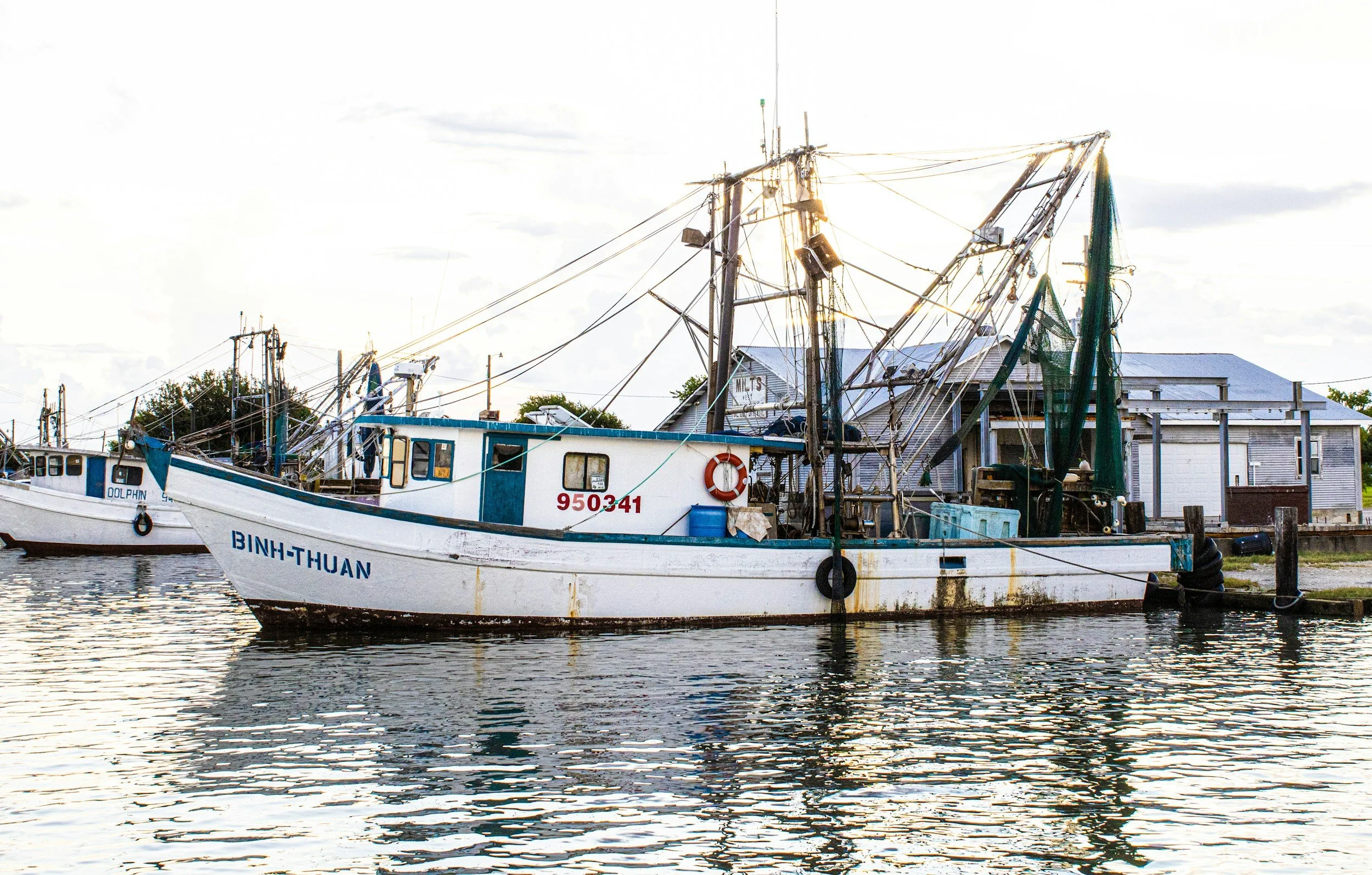
Here is the part that gets lost when the story starts in a restaurant: Vietnamese and Cambodian shrimpers make up a substantial share of Louisiana's shrimping workforce to this day, and for as long as they've worked these waters, crews have come in after long hauls at sea and cooked for themselves, dockside, out of whatever they'd just pulled up. No menu. No name. No customer to please but each other.
When you're cooking for your own crew instead of the regulars at a Cajun seafood counter, you season it the way your own palate actually wants it. For a lot of Vietnamese cooks, that meant pulling back on the raw heat of a traditional Cajun spice mix and leaning into something closer to the flavor logic of Vietnamese cooking generally — a balance of sweet, sour, salty, and heat, rather than heat alone. A little sugar. A little citrus. That instinct, worked out informally over countless dockside meals with no audience and no stakes, is the actual root of what people now call Viet-Cajun flavor.
The Southern Foodways Alliance, an institute at the University of Mississippi dedicated to documenting Southern food culture, has spent real time studying exactly this intersection — the Gulf Coast's Vietnamese shrimping communities and the food they built almost by accident, out of necessity and homesickness in roughly equal measure.
Two Deltas, Closer Than They Looked
Part of why the fusion took so naturally, once it started, is that Vietnamese and Cajun food culture had more in common going in than most people assume. Both trace part of their culinary DNA to French colonial rule — Vietnam from 1887, Louisiana from more than a century earlier — which is part of why a bánh mì and a po'boy aren't as distant as they look on paper: bread, meat, and a colonizer's baguette technique, reworked by the people who actually had to live under that rule into something entirely their own.
Both cultures are Delta cultures, full stop — the Mekong and the Mississippi, rice-growing, seafood-dependent, humid, communal, built around long tables and shared pots rather than individual plates. A Vietnamese meal and a Cajun boil are both, at their core, built for a group to sit around and pick at together for hours. That overlap made the blending feel less like fusion cuisine and more like two food cultures recognizing something familiar in each other.
Katrina, the Spill, and a Second Test
If the late '70s and early '80s were the community's first trial by fire, 2005 and 2010 were the second. Hurricane Katrina devastated fishing communities across the Gulf Coast, and New Orleans East — the heart of Vietnamese New Orleans — was no exception; homes, boats, and processing operations were lost or badly damaged.
Five years later, the Deepwater Horizon oil spill hit the same communities again, this time by shutting down the waters themselves rather than the land. Organizations like Coastal Communities Consulting, a real advocacy group that worked directly with Vietnamese fishermen and shrimpers, many of whom didn't speak English fluently, helped families navigate the process of securing disaster relief they were entitled to but might never have known how to claim on their own.
The community rebuilt. New Orleans East's Vietnamese population and its institutions — churches, markets, restaurants — came back, and in many cases came back stronger and more visible than before. It's worth sitting with that for a second before biting into a plate of Viet-Cajun crawfish: the flavor didn't just survive one hard chapter of Gulf Coast history. It survived several, and it's still here.