
Crawfish Season 2027: What 2026 Taught Us and What to Expect Next Year
Last year we wrote a guide to the 2026 crawfish season before it started. It was a forecast. This one is different, because now we have a full season of real numbers to look at — and because the conditions that will determine the 2027 season are happening right now, in the fields, this month.
If you're planning a boil, a wedding, a bachelor weekend, or a company party for next spring, this is the piece that tells you what it's actually going to cost and when to book.
We're Rougarou Shuckers & Crawfish. We boil for private events across New Orleans, and we buy crawfish at wholesale every week of the season. What follows isn't theory — it's what we watched happen from the buying side.
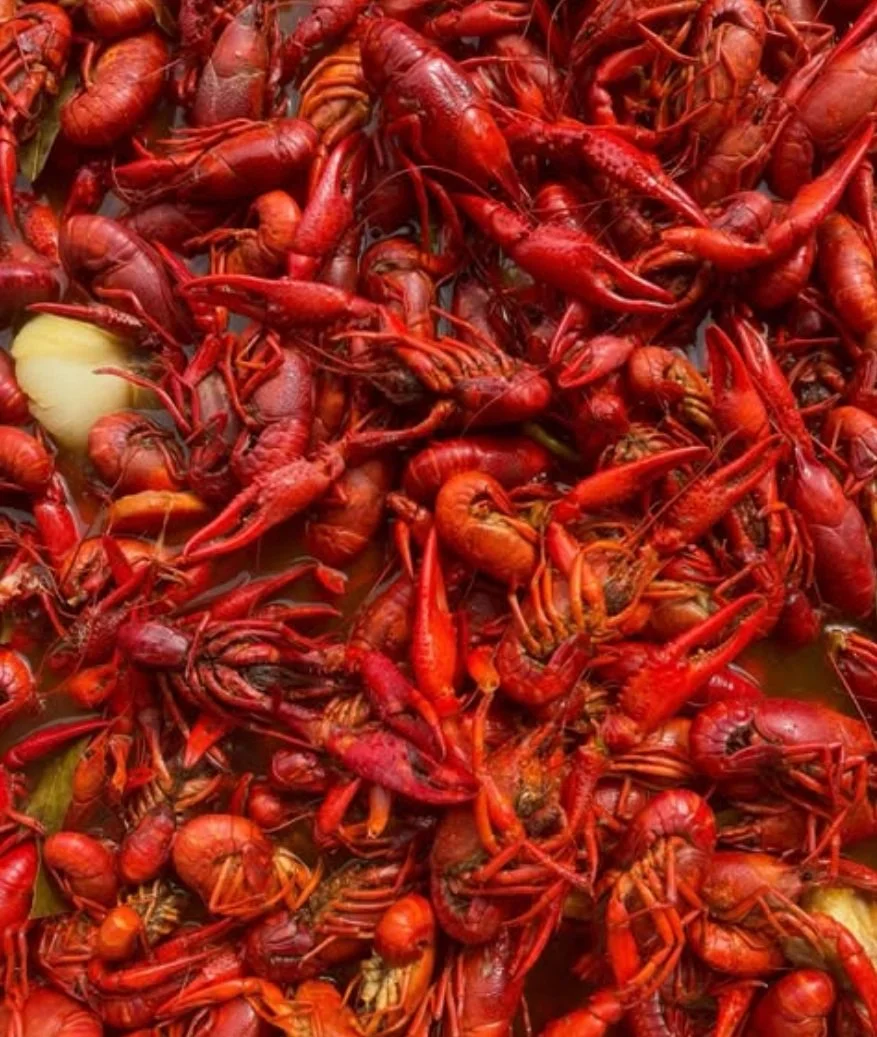
A Rougarou Crawfish Boil March, 2026
WHAT ACTUALLY HAPPENED IN 2026
The LSU AgCenter went into the 2026 season predicting a "normal" year. Todd Fontenot, their crawfish extension agent, said stocking had gone well, rice harvest conditions were favorable, and there had been no early freezes. Rice stubble was in good shape, and fields hadn't been rutted by harvest equipment.
By the numbers, they were mostly right. But "normal" turned out to be a more complicated word than it sounded in December.
THE PRICE CURVE, MONTH BY MONTH
That's a swing from roughly $7.24 down to $2.99 per pound for live crawfish across a single season. If you're planning an event, that spread is the single most important number on this page.
We're building our own crawfish price tracker for the 2027 season — week-by-week wholesale numbers from what we're actually paying, not retail averages. If you want it when it goes live, get in touch and we'll send it to you.
THE PROBLEMS NOBODY PREDICTED IN DECEMBER
The season looked clean on paper going in. In practice, three things made it harder than forecast.
Dry conditions and pumping costs. Producers faced elevated expenses in the fall of 2025 because dry weather forced them to pump more water to flood their ponds. That cost carried into the season. It was far less severe than the prolonged 2023 drought that sent supplies plummeting, but it wasn't nothing.
Low oxygen from warm temperatures. Warmer-than-normal fall temperatures pulled oxygen levels down in some ponds, causing limited losses of young crawfish before the season even started.
Apple snails. This is the one worth paying attention to. Apple snails are an invasive species, found primarily south of Interstate 10 where producers use surface water. They compete directly with crawfish for oxygen and nutrients, and they clog traps — which means harvesters spend time clearing snails instead of pulling crawfish. Fontenot flagged them as a growing concern going into 2026, and by peak harvest in April, they were still reducing production in surface-water ponds.
By mid-season, the assessment had shifted from "normal" to something more honest: a mixed bag. Farmers were in peak harvest with an average catch, working against dry conditions, rising energy costs, and a snail problem that isn't going away on its own.
WHY THIS MATTERS IF YOU'RE BOOKING AN EVENT
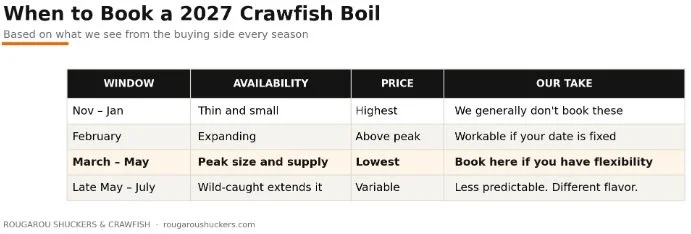
The gap between January crawfish and April crawfish isn't just about price. It's about size and quality too.
Early-season crawfish are small. They're less active in cold water, which makes them harder to trap, which is why supply is thin and prices are high. That's not a market failure — it's biology, and it happens every single year.
By late March and April, the same crawfish have spent months feeding and growing. They're bigger, they're moving, and there are far more of them. You get better product at roughly half the price.
This is why we don't book January boils. We've turned down January inquiries, and we'll do it again. Charging a client peak-season prices for small, thin early-season crawfish isn't a deal we want to be part of. If you want crawfish in January, go to a restaurant that's already eating the cost. If you want a boil worth remembering, wait for February at the earliest and aim for March through May.
THE 2027 SEASON: WHAT WE'RE WATCHING RIGHT NOW
Here's the part most guides get wrong. The 2027 crawfish season isn't determined in January 2027. It's being determined right now, in September and October 2026, in fields across south Louisiana.
Crawfish spend the summer in burrows. Females carry fertilized eggs down there through the hottest months. When fall rain softens the mud plugs sealing those burrows, the crawfish emerge into flooded ponds and start feeding. Everything about next spring depends on that emergence going right.
THE THREE THINGS THAT DECIDE 2027
1. Fall rainfall, September through November 2026.
This is the big one. Moderate, consistent rain in October and November is ideal — enough to soften burrow plugs and flood ponds properly, spread out enough that it doesn't trigger a premature emergence.
Too little rain and farmers have to pump, which costs money and often means ponds flood late or unevenly. That's exactly what happened going into 2026, and it showed up as higher input costs all season.
Too much rain too early — heavy August or September storms — can pull crawfish out of their burrows before conditions are right, which hurts survival rates and thins the spring harvest.
2. The rice crop and stubble condition.
Most Louisiana crawfish come out of a rice-crawfish rotation. Farmers harvest rice, then flood the same fields to grow crawfish in the off-season. The rice stubble left standing becomes the food source and habitat for the crawfish underneath.
Good rice harvest weather means good stubble. Wet harvest conditions mean combines rut the fields and tear up the stubble, which hurts the crawfish that follow. Going into 2026, stubble was in good shape statewide except in parts of southwest Louisiana where dry conditions limited regrowth.
3. Winter temperature, December through February.
Crawfish grow through the winter. Louisiana's mild winters usually let them keep feeding and developing without interruption. Short freezes are fine — crawfish slow down, then bounce back when it warms.
The problem is extended cold. Prolonged stretches below freezing stall growth entirely and push the whole season back by weeks. That's the difference between plentiful, large crawfish by mid-March and thin, small ones into April.
OUR HONEST READ RIGHT NOW
We don't have 2027 numbers yet, and anyone selling you a confident forecast in September is guessing. What we can say:
The apple snail problem is structural and getting worse, not better. It's concentrated south of I-10 in surface-water ponds, and there's no quick fix coming. That's a persistent drag on supply in specific growing regions.
Energy and pumping costs have been climbing for three seasons. Those costs get passed forward. Even in a good production year, don't expect a return to the prices of a decade ago.
And the baseline is still strong. Louisiana produces roughly 150 million pounds of crawfish in a normal year, supporting a $300 million industry across more than 1,500 farming families. The infrastructure is deep and it recovers well. 2024 was a bad year. 2025 was better. 2026 was mixed but functional. The industry absorbs shocks.
PLANNING A BACHELOR OR BACHELORETTE WEEKEND?
Crawfish season overlaps almost perfectly with bachelor and bachelorette season in New Orleans. If you're bringing a group into town between February and May, a boil is the one thing your crew genuinely cannot get anywhere else.
We run these two ways: live on-site at your rental with the pot, the burner, and the whole show, or boiled fresh at our kitchen and dropped off hot when a property doesn't have the outdoor space. Both are the same crawfish and the same seasoning blend.
We've done enough of these that rental owners around the city know our name, and we deep-clean our area before we pack up — so your host gets the house back spotless and your deposit comes back.
HOW WE BUY, AND WHY IT MATTERS
A few things that separate a good boil from a mediocre one, since most people never see this side of it.
Direct wholesale relationships. We buy direct rather than retail, through relationships we've built over years. That means we know exactly what's coming in, and we're not paying a middleman markup that ends up on your invoice.
Our own seasoning blend. Not the bag mix. We built it, we adjust it, and it's the thing people ask about after the boil.
We don't compromise on size. If the crawfish coming in aren't good enough, we say so rather than serving them. That's easier to do when you've built the relationships to have options.
THE BOTTOM LINE
The 2026 season delivered on price by April — down to $2.99 a pound for live crawfish by Memorial Day — but it took real work from farmers fighting dry conditions, energy costs, and an invasive snail problem to get there.
For 2027, watch the rain this fall. If October and November bring steady, moderate rainfall across south Louisiana, we're set up for a good spring. If it stays dry, expect higher input costs and later availability, same as this year.
Either way: book March through May, book early, and don't pay January prices for January crawfish.
Planning a boil for spring 2027? We're taking dates now. Get in touch and we'll hold your date before the season fills — and we'll add you to the list for our 2027 price tracker.
Rougarou Shuckers & Crawfish — Best New Crawfish Pop-Up, New Orleans 2026. Preferred vendor at Race + Religious and Derbès Mansion. Featured in The Gambit.
Season data compiled from LSU AgCenter reporting, The Crawfish App pricing indices, and Louisiana Department of Wildlife and Fisheries figures.
